 Tanish Manku
1abfc3457a
The first cut was a naive fetch-and-push that raced its own hydration:
an async server-wins pull could clobber edits made while it loaded, a
just-reloaded (empty) canvas could overwrite the server document, a
module one-shot flag let a second account in the same page load keep
writing to the first account's rows, failed saves silently fell out of
the dirty set, and canvas edits were attributed to whichever board was
active at flush time.

Sync is now replication between durable replicas:

- The canvas persists locally per board (localStorage, blob-stripped),
  ending the 'empty because it just loaded' state entirely - reloads
  restore the canvas even logged out, and there is no window where a
  hollow canvas can masquerade as user intent.
- Saves are gated behind a hydration state machine (idle/hydrating/
  ready); nothing pushes from a partially loaded session.
- Dirty state is per board and durable (Board.needsSync persists), so
  closed tabs resume their pending push next session; pagehide flushes
  flags and replica synchronously.
- Hydration is dirty-aware last-write-wins - clean boards take the
  server copy, dirty boards keep local content and push it - with
  per-board error isolation and bounded concurrency.
- Sync is account-scoped: hydration re-runs per user id, and boards
  stamped with another account's ownerId are never pushed (localStorage
  is machine-shared; server rows must not be). The adapter seam now
  exposes getUserId/subscribeAuthState instead of a boolean.
- Failed pushes stay dirty and retry with exponential backoff; deletes
  are tombstoned so offline deletes can't resurrect on next hydration;
  save status reflects real dirty state (never 'Saved' with edits
  pending).
- Media whose token no longer resolves renders a visible placeholder
  that is never persisted, so resolution self-heals on every load.
- Grid multi-image drops place all tiles immediately again (uploads
  moved to background write-back), and canvas edits are attributed to
  the board that owned the canvas at edit time.

Webapp adapter: session user token as the account id, and the raw
document/delete/resolve fetches wrapped so a network rejection degrades
to a per-board failure instead of aborting hydration.
The IDE for artists.


ArtCraft
ArtCraft is the IDE for interactive AI image and video creation. We turn prompting into crafting, so your ideas become a form of tangible expression and computing. This is Adobe Photoshop for everyone, and we're giving away the source code!
Show, Don't Tell: Advanced Crafting Features
Text-to-image is great, but artists need control. It's important to know what your image will look like before you generate it, and it's vitally important to achieve consistency and repeatability.
| Feature | Demo + Explanation |
|---|---|
| Image to Location | |
| 3D Image Compositing | |
| 2D Image Compositing | |
| Image to 3D Mesh | |
| Character Posing |  You can dynamically pose your characters to achieve the precise character, scene, and camera blocking before calling "action". |
| Scene Blocking w/ Kit Bashing | |
| Character Identity Transfer | |
| Background Removal | |
| Mixed Asset Crafting | 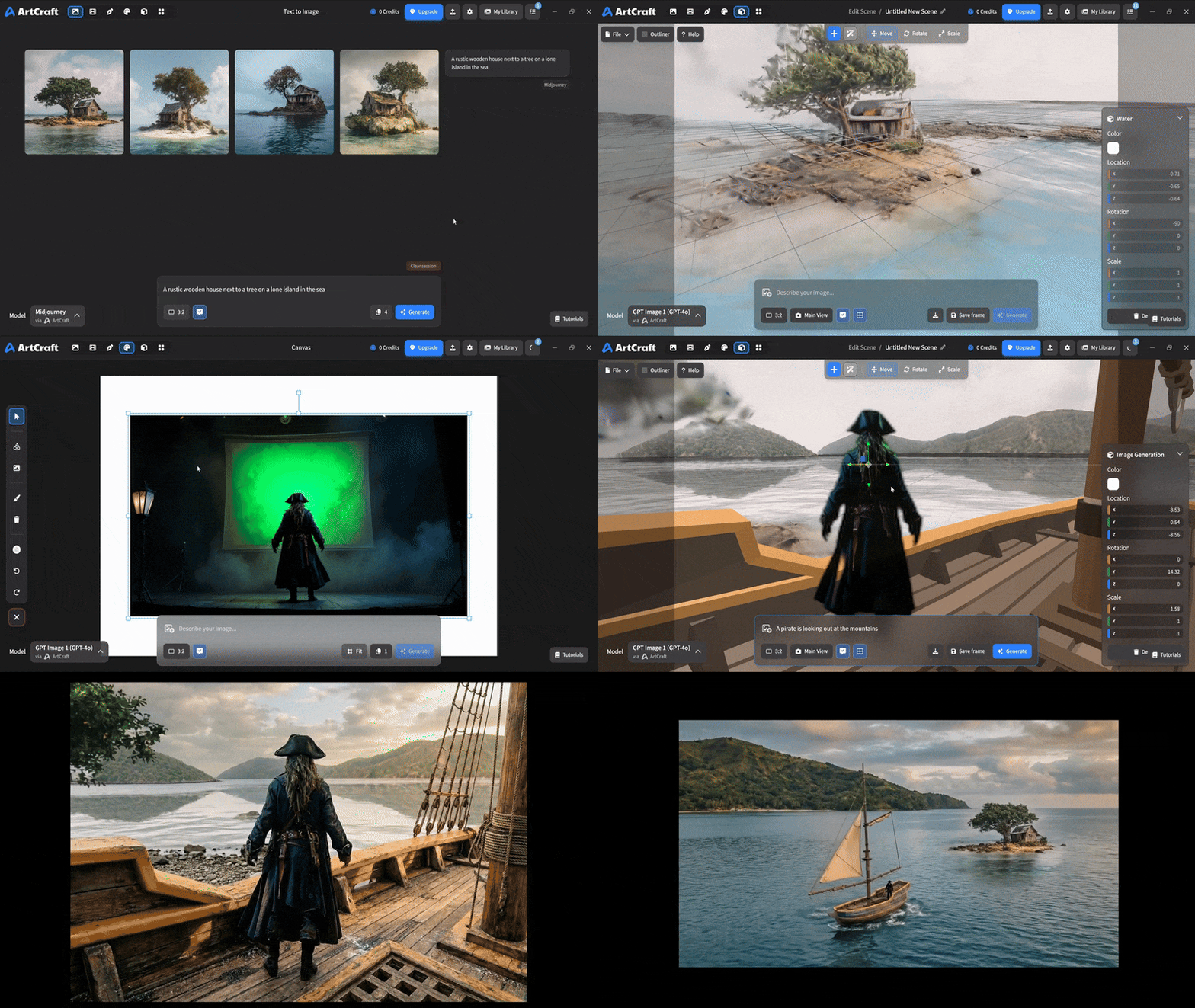 You can use image cutouts, worlds, and simple 3D meshes all together to precisely and intentionally lay out your scenes. |
| Scene Blocking | (preview coming soon) |
| Canvas Editing | (preview coming soon) |
| Scene Relighting | (preview coming soon) |
Note: all of the above videos were generated for free with Grok Video; the cost to build this README was negligible.
Quick and Easy Prompting
We haven't abandoned text-to-asset generation for quick prototyping and ideation. We support every popular workflow in a first class fashion.
| Feature | Demo + Explanation |
|---|---|
| Text to Image | |
| Image Editing | |
| Image Editing | |
| Image to Video | |
| Image Inpainting | (preview coming soon) |
| Image Ingredients | (preview coming soon) |
Models and Providers Supported within Artcraft
| Provider | Features |
|---|---|
| Artcraft | Nano Banana, Nano Banana Pro, GPT-Image-1 / 1.5, Seedance 1.0 Lite / 1.5 Pro / 2.0, Seedream 4 / 4.5, Flux 1.1 / Kontext, Veo 2 / 3 / 3.1, Kling 1.6 / 2.1 / 2.5 / 2.6, Sora 2 / Pro, Hunyuan 3d 2 / 3 |
| Grok | Grok Imagine, Grok Video |
| Midjourney | Image Gen (all versions) |
| Sora | Sora 1, Sora 2, GPT-Image-1 |
| WorldLabs | Marble (Gaussian Splat World Generation) |
We're going to be adding the following providers soon: Kling (via Kling website accounts), Google (via API keys), Runway (via website account), Luma (via website account).
We're potentially interested in adding other aggregators for those who already have subscriptions and credits at those providers, for example: OpenArt, FreePik, etc.
Downloads
- Visit our website for the stable Windows and MacOS releases
- Or you can grab a more recent Windows and MacOS build directly
- Linux requires building from source for now